


 Washington Wizards Logo PNG
The Wizards — they used to be the Bullets — won their only championship way back in ’78. They got to the Finals a few times back then too. Since then, it’s been kinda hit or miss. They’ve grabbed some division titles here and there, but not always in the playoffs. Still, when they’re good, they can mess with the top teams in the East.
Meaning and history
Wes Unseld. Elvin Hayes. 1978 champs. Not flashy, just relentless. All these names we associate with the NBA team, named Washington Wizards. DC had a squad that reflected its city—hard-working, no-nonsense, built for battles.
They were founded as the Bullets, and this name did fit pretty good, however, in the 1990s it was decided to change it to the Wizards, and it stuck for decades.
Then came Wall and Beal. The backcourt of the future. Lightning-fast, smooth as silk. They had the crowd rocking again—especially when the playoffs came to town. The team didn’t go all the way, but the city believed. Still does.
Lately? Another rebuild. But Jordan Poole’s got flair. Deni’s emerging. Young guys hungry. And even when the wins are hard to find, the fans keep showing up. Because DC hoops runs deep—from streetball to the pros, it’s always mattered here.
They’ve had eras of magic, eras of mess. But the Wizards are still here, still pushing. The next chapter’s coming—it’s just a matter of time.
1961 – 1962

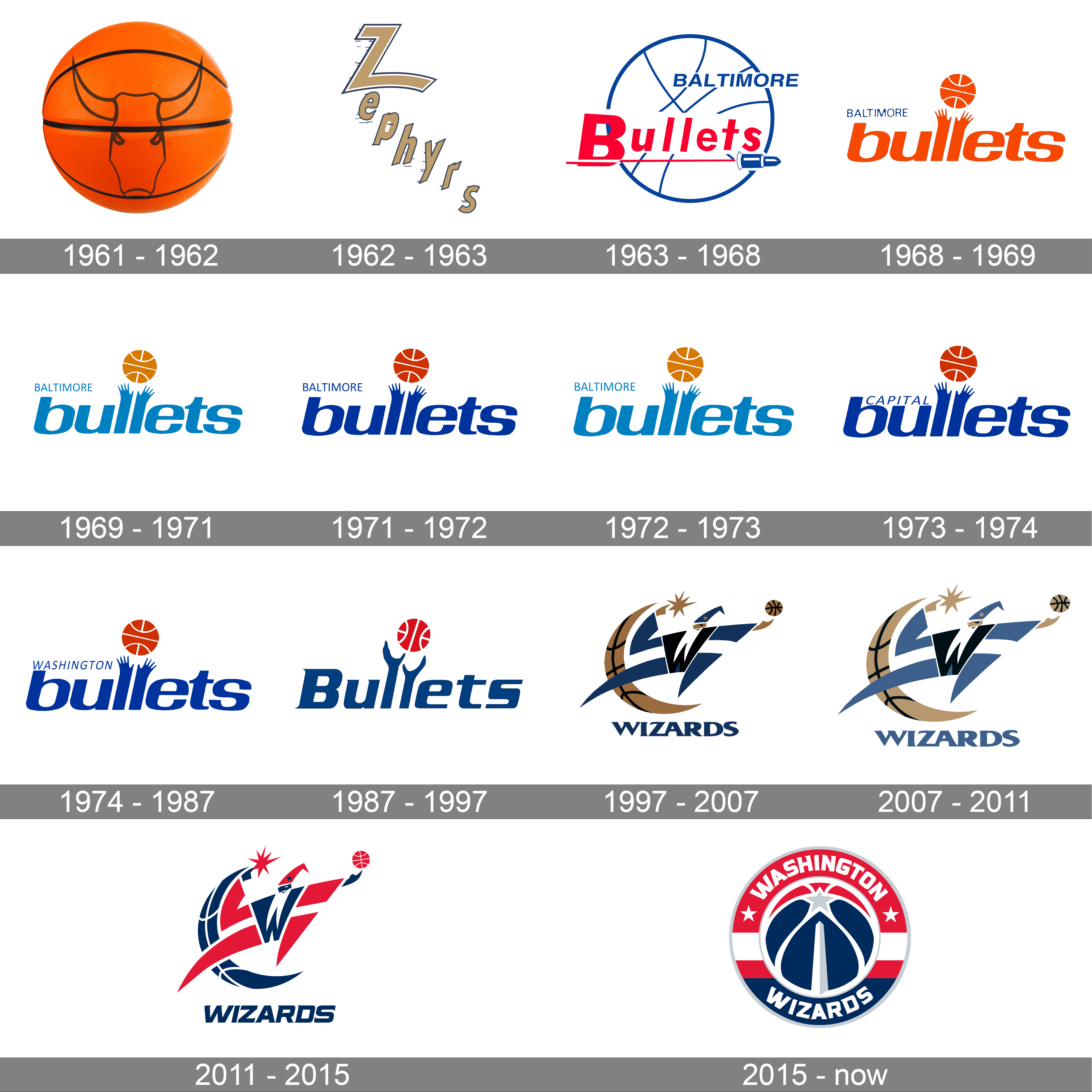
The very first logo of the team, used for just one season in 1961, featured a depiction of a classic orange basketball with a contoured image of a bull’s head on it. The emblem was executed in a very progressive and minimalistic style, which made the whole badge look strong and confident. No lettering was added to the composition.
1962 — 1963

Named after the Ancient Greek god of the west wind the team played for a couple of seasons. And yes, the players wanted to be as fast as the wind. But we are talking about the logo, which was composed of a diagonally-placed custom hand-written lettering in smooth gold, with each of the massive characters outlined in white and blue, and the elongated tail of the “Z” making the main eye-catching element of the composition. The badge stayed active for just one season.
1963 — 1968

In 1963 Zephyrs relocate to Baltimore and become Baltimore Bullets, with the new logo introduced in the same year. It was a white basketball outlined in blue with a red sans-serif “Bullets” lettering and smaller size blue “Baltimore” above it.
1968 — 1969

The redesign of 1968 created a new emblem for the club. It was a bold stylized inscription in the lowercase, where the smooth red lettering had its double “L” drawn as two hands with a bright red basketball above them. The blue “Baltimore” inscription was placed above the main logo.
1969 — 1971, 1972 — 1973

The following redesign was all about the color palette of the badge. It did change the solid orange letters to medium-dark blue, which looked fresher and cleaner, and more pleasant to the eyes in general. The orange shade stayed with the basketball, but was also refined, becoming lighter and calmer. This badge was used fore two seasons in the end of the 1960s, and then came back for another one in the 1970s.
1971 — 1972

Another experiment with the Bullets’ color palette was held in 1971. This time both blue and orange shades got darkened up and intensified. Especially the blue, which gained a super cool and deep electric shade, creating a brighter composition with a strong feeling of confidence and excellence.
1973 — 1974

The name of the club was changed to Capital Bullets in 1973, after their relocation to Washington. As for the emblem, it remained the same, only the “Baltimore” lettering was replaced by the “Capital”, executed in the same blue color.
1974 — 1987

The name of the club was changed to Washington Bullets in 1974. The badge remained untouched, as well as its bright blue and red color palette, just the “Capital” wordmark was replaced by the “Washington”.
1987 — 1997

In 1987 the Washington Bullets logo was redesigned. Its iconic lowercase inscription was switched to a title case, and the contours of two “hands” were redrawn in a more minimalist and smooth manner.
1997 — 2007

The name of the club changed to Washington Wizards in 1997, and the completely new logo is being introduced in the same year. The new emblem features a stylized image of a wizard in a light blue color palette, with a gold moon on his left, having a pattern of a basketball, and a gold and black ball above his right hand. The “Wizards” wordmark was placed under the image written in all capitals of a modern serif typeface.
2007 — 2011

The redesign of 2007 was aimed to create a more delicate and sleek look of the Wizards’ badge, and it worked just perfectly. The shades of blue and gold became lighter and softer, with the black creating main accents and adding strength and brutality to the stylish and sharp composition of the team’s badge. This version stayed untouched for four seasons.
2011 — 2015

The color palette of the Washington Wizards’ visual identity was changed to navy-blue and red in 2011. The wordmark was now executed in an italicized sans-serif typeface with rounded angles and some tails of the letters sharpened.
2015 — Today

The redesign of 2015 brought a new look to the Wizards’ emblem, and now it is a circular badge with a stylized blue and white basketball enclosed in a thick red and blue frame with white lettering around its perimeter. The inscription is executed in a fancy sans-serif typeface with bold smooth lines.
Uniforms
The players of the Washington Wizards franchise have a choice of two uniforms to wear on different occasions: the Association Uniform, which consists of white jerseys and shorts, decorated by red side stripes and inserts on the top of the front panels, and thick blue horizontal lines, placed under the wordmarks; and the Icon Uniform, composed of red shorts and T-shirts with black side stripes and a white horizontal one under the white lettering on the chests.
Font and Color
The lettering seen on the Washington Wizards new logo appears to have been inspired by Friz Quadrata Bold, which is a glyphic serif typeface created by Ernst Friz in collaboration with Victor Caruso. The same font was the basis of the wizard/crescent logo, too. It has been heavily modified for the newer logo, though.
The Washington Wizards logo font is bolder and narrower, while the italicized effect is gone. The letters in the current version don’t have enough “breathing space” and, because of it, the insignia isn’t particularly legible at smaller sizes.
All the colors of the official palette – red (PMS 186), navy blue (PMS 289), and silver (PMS 877) – can be seen on the logo Washington Wizards use as the global one. White is used as an additional color.
NAVY BLUE
PANTONE: PMS 289 C
HEX COLOR: #002B5C;
RGB: (0,43,92)
CMYK: (100,64,0,60)
RED
PANTONE: PMS 186 C
HEX COLOR: #E31837;
RGB: (227,24,55)
CMYK: (0,100,81,4)
SILVER
PANTONE: PMS 877
HEX COLOR: #C4CED4;
RGB: (196,206,212)
CMYK: (5,0,0,20)


