


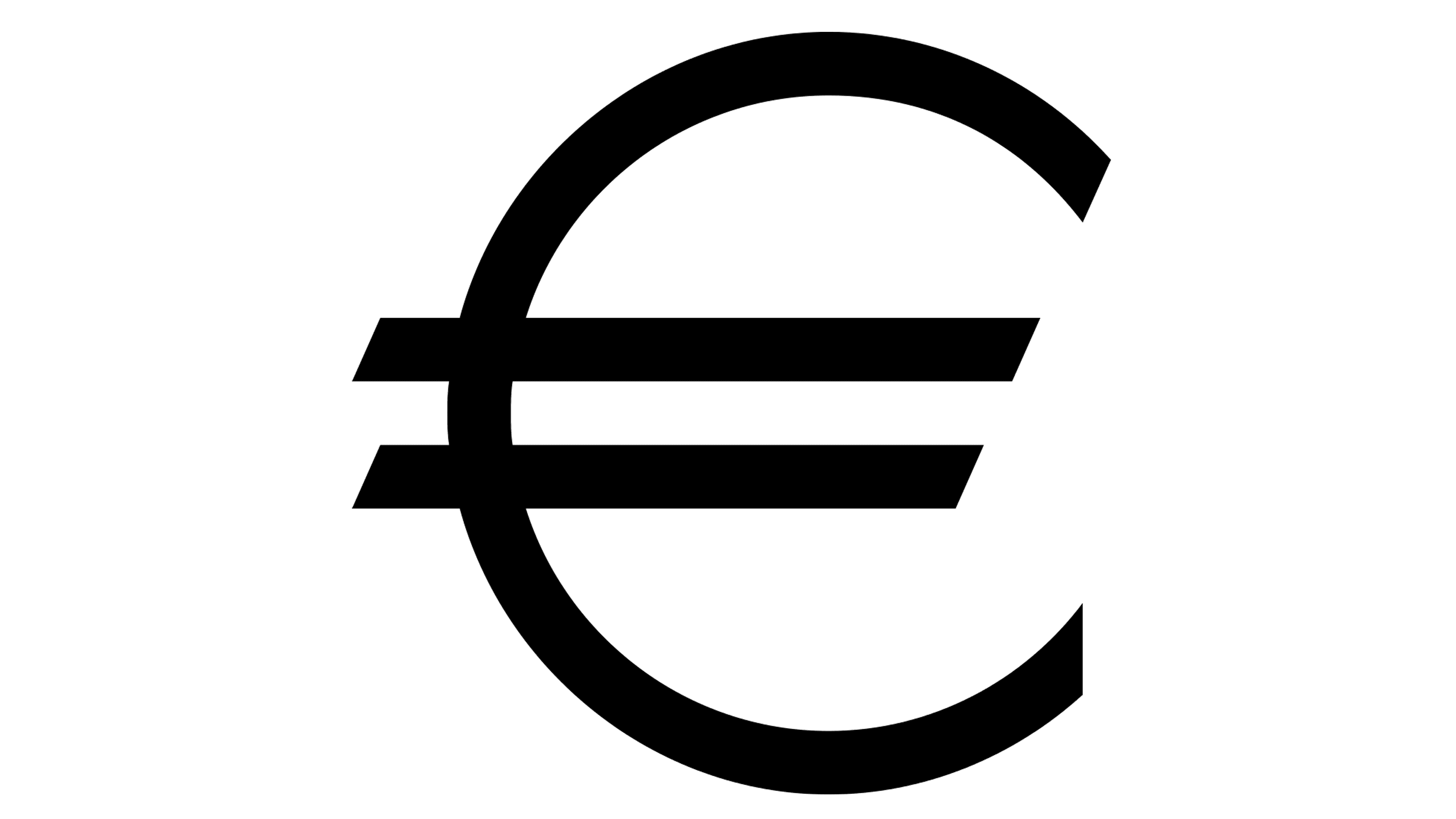
 Euro symbol PNG
The euro symbol (€) is a visual representation of the official currency of the whole Eurozone. It is the currency of 20 (out of 27) countries that form the European Union. It became associated with economic unity and stability within the Eurozone. Although it acquired its own unique symbol relatively recently compared to other currencies, the euro plays a vital role in international finance, trade, and economic stability. The fact that it is the second most traded currency after the U.S. dollar is the best proof. This makes it one of the most recognizable signs in any country. Its adoption shows Europe’s collective effort towards economic integration and a unified image in the global economy.

History of the € Symbol
The idea of a single currency was born much earlier than it was officially presented to the world, after World War II. The European countries saw it as a way to preserve peace on the continent. It was believed that strong financial, social, and political relations would negate the threat of war.
The Symbol of the Euro currency was conceived back in 1996. A year earlier, the European Council made a final decision on its name – euro. It was meant to become a single unified currency of the EU. Given the high hopes for the new currency, the design of the symbol was chosen after several rounds of internal competition. There were over 30 design options to choose from.

Although there are disputes on who contributed to the final design, the official version attributes it to Alain Billeri. He is a graphic designer at the European Commission. Some still believe that this is the chief designer of the European Community, Arthur Eisenmenger. He led the development of the EU flag symbol. Others believe that the author is Robert Kalina, the chief designer of the Central Bank of Austria. Some attribute the authorship a whole group of developers. The EU did not officially comment on the rumors.
The symbol was approved by the European Council in 1997. This approval marked a significant step in establishing a visual identity for the euro. It ensured its recognition and adoption across member states and beyond.
Symbol Design and Meaning

Although the euro design is simple, it is also deeply symbolic.
- First of all, the symbol stands for “Europe” as it resembles the letter “E.” It is meant to emphasize the currency’s continental scope.
- The two horizontal parallel lines going across the “E” are stand for stability and strength. These qualities are essential for a reliable currency.
It is possible to see two version of this symbol. The standard form is €. It is typically used in informal or visual communication. More formal uses turn to the three-letter ISO 4217 code – EUR. These three letters can be seen in international banking, trading, and accounting.
How to Use the Euro Symbol
Spelling rules
In most EU countries, the symbol is placed after the amount of money. For example, you would write 50€. Ireland and some other countries, though, add it before the amount: €50. This reflects English-language conventions.
Encoding and entering the symbol on different devices
The euro symbol has the Unicode code point – U+20AC.
The following shortcuts allow the euro symbol to be used across digital platforms and programming environments with ease.
Windows: Hold the Alt key and type “0128” on the numeric keypad.
Mac: Press “Option + Shift + 2”.
Linux: Press “Ctrl + Shift + u”, then release and type “20AC”, followed by Enter.
Graphic Tip: When incorporating the euro symbol, designers should consider using internationally recognized fonts (like Arial, Times New Roman, or Helvetica). This will help ensure consistent and accurate display across platforms.

Interesting facts about the € symbol
- The euro symbol is inspired by the Greek letter “Epsilon” (ε). Greece is considered to be the cradle of European civilization. This also hints at the classical civilizations in general.
- Some fonts display the symbol differently, with varying curvature or line thickness. Yet, the euro symbol is not a sign, but rather a logo. Accordingly, it should look the same in all encodings and fonts.
- When compared to other currencies, it got its own symbol quite late. It was introduced much later than the U.S. dollar ($), British pound (£), and Japanese yen (¥).
Conclusion
Each currency symbol is more than just a sign for money. It is also the country’s cultural and economic identity. The euro is a powerful symbol of European economic interconnection. It also holds a prominent place in the economy beyond the EU borders. Its simple yet meaningful design makes it familiar to most people. The sign promotes trust among consumers, businesses, and governments worldwide. As the euro continues to grow in global importance. This symbol stands as a testament to the EU’s desire for unity and financial stability.


