


 Hashtag Symbol PNG
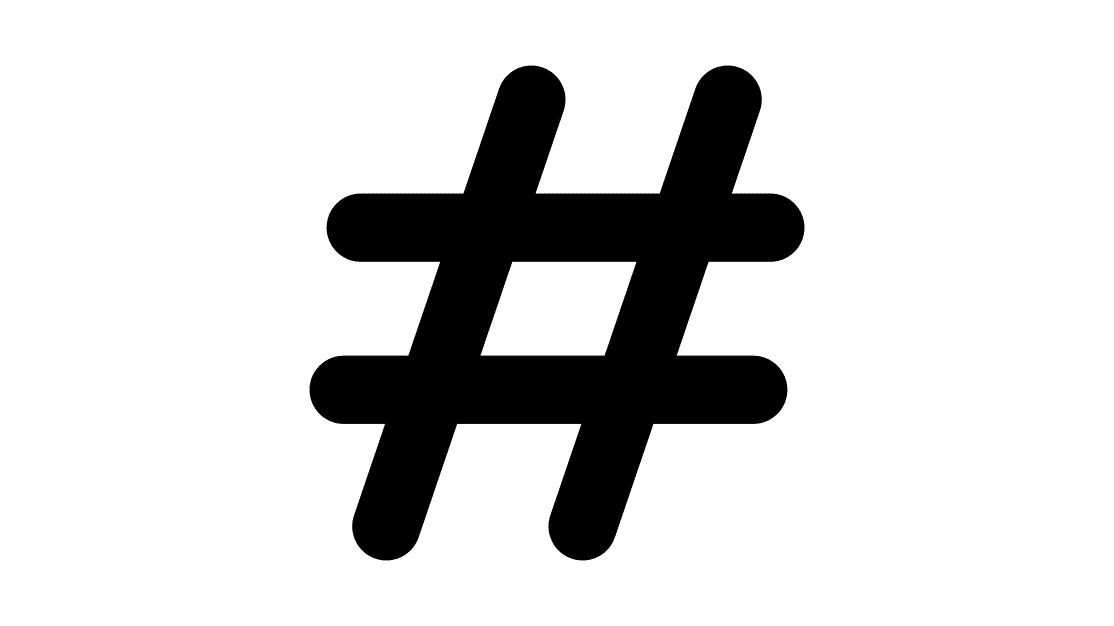
Kids draw it all the time without a second thought, since it’s the same grid they use for tic-tac-toe, just with two of the lines tipped over a bit. The name is where things get messy. Older Americans still tend to call it the pound sign. A form asking for an apartment number says number sign. A Londoner says hash. And anyone who has spent five minutes online just says hashtag. It’s all the same #, though. Only the job changes.
Meaning and History

Oddly enough, the story probably starts with weight. A Roman pound was a libra pondo, and that old phrase is the reason English writes lb for pounds even now. Scribes copying it out by hand usually dragged a stroke across the top, which was how they flagged a shortcut back then. On the page it came out looking like ℔.
That crossed lb got written by hand thousands upon thousands of times, and the letters wore away bit by bit until mostly the lines were left, two going down and two going across. That’s the explanation most historians lean toward. The steps in between are a bit patchy, so it’s fair to call it likely rather than proven.
By the 1800s Americans were using the sign all the time in shops. Written after a number it meant pounds, so 10# of flour was ten pounds of it. Written before a number it meant “number,” which is why a pencil could be a #2. Remington put the sign on one of its typewriters in the 1880s, and after that pretty much every American office had one within reach.
The weirdest name came from the phone company. In the 1960s Bell Labs was getting ready to put # and * on touch-tone keypads, which reached homes in 1968, and the engineers wanted a word for the sign. They went with “octothorpe.” Octo is easy enough, since the thing has eight ends poking out. The thorpe half is where it gets murky.
One story says an engineer named Don Macpherson admired the Olympic star Jim Thorpe. Another, told by former Bell staff years later, says somebody just tacked on a sound that seemed vaguely Greek. Nobody has settled it. The word didn’t catch on much either, outside phone manuals and quiz nights.
Computers gave the sign its next life. Somewhere around 1988 the people behind IRC, an early chat network that students and programmers loved, decided chat rooms should start with #, which is why the room for Linux fans was called #linux. Nearly two decades went by. Then, on August 23, 2007, Chris Messina, a designer who spent much of his time on the young Twitter, threw a question out to his followers. How did people feel about using # (pound) for groups, as in #barcamp? A few days later the blogger Stowe Boyd called these things “hash tags,” and that name stuck.
Twitter itself took its time. For a while people just typed the tags by hand and searched for them. It wasn’t until 2009 that a tag turned into a link people could actually click, and the trending list on the home page showed up the year after. Other platforms copied the idea after that.
The Use of the Symbol

Where the sign sits makes all the difference. Americans who see #3 just say “number three,” and a #1 song is simply the one everybody’s humming that month. Flip it around, 5# instead of #5, and an old-time grocer would have read it as five pounds, a habit that hangs on mostly in shipping departments and a few hardware stores. Careful writers tend to steer clear of both and write “No.” or spell out “pounds” instead.
Online, stuck to the front of a word, it becomes a hashtag. #WorldCup, for instance. One click on it brings up all the other posts with the same tag. Spaces break a tag, so longer ones get squashed together, and capital letters help a great deal there. #ThrowbackThursday is much easier on the eyes than #throwbackthursday.
Saying it out loud is its own little puzzle. Americans tell callers to press the pound key. In Britain it’s the hash key. It’s the same button either way, and somehow nobody ever seems to press the wrong one.
Use in Different Fields
Numbers and Lists

Americans use # for “number” just about everywhere. Receipts have it, apartment buzzers have it (#4B), and so does the kid on the basketball team wearing #23. Across the Atlantic people would usually write No. in those spots, which is part of why the habit feels so American.
Telephones

Phone makers parked it in the bottom right corner of the keypad, across from *, back in the 1960s, and it hasn’t moved since. Automated phone systems love it. Most of the time hitting it is the caller’s way of saying “okay, I’m finished,” right after punching in a PIN or a long account number. Some menus treat it more like a shortcut, handy for skipping a recording nobody wanted to hear anyway.
Programming and the Web

Programmers have found a few homely uses for it. Somebody writing Python can start a line with # and jot down a reminder, and the computer politely pays no attention. In C, a #include line gets dealt with before anything else happens, a bit like setting out the ingredients before cooking. And the odd-looking #! at the very top of many scripts is there to say which program is supposed to run the thing.
On web pages, # points to one specific place. That’s how a link ending in #history manages to drop a reader halfway down a long article, right at the part about history. Designers lean on it whenever they pick a color too, and #FF0000 is how a web page says plain bright red.
IRC and Early Chat

IRC is where # first marked a topic. People hopped between rooms called #help or #music, sometimes dozens of them in one evening. There was a small rule behind it, too. A room with # in front was shared across the whole network, while one with & stayed on a single server. Today’s hashtag is basically a grandchild of that habit.
Social Media

Twitter may have gotten there first, but the idea was never going to stay put. By 2011 Instagram had caught on, and it didn’t take long before photos of somebody’s lunch were showing up with twenty or thirty tags underneath. Facebook held out until 2013 before joining in. TikTok is the extreme case, since one silly tag there can be everywhere by the end of the week.
Not every tag is about going viral. A conference picks one so people at home can follow along. A TV show puts one in the corner of the screen on premiere night. When a storm rolls in or a wildfire spreads, people use a local tag to keep each other posted, and that goes all the way back to the fires around San Diego in the fall of 2007, only weeks after Messina’s tweet.
Marketing and Movements
Brands figured out fast what a hashtag could do for them. A tag printed on a billboard gets people posting about the product, and the company gets to watch. Sometimes it backfires. More than one campaign has ended up flooded with complaints from customers who grabbed the tag for themselves.
Activists and charities caught on just as quickly as the brands did. #BlackLivesMatter has been around since 2013, and 2014 was the summer when everybody seemed to be dumping ice water over their heads for the #IceBucketChallenge, all to raise money for ALS research. A few years later #MeToo jumped from country to country in a matter of weeks. Each time, the tag gave thousands of separate posts one place to gather.
Proofreading, Chess and Other Corners

Some of the older jobs are still around. Proofreaders have been writing # in the margin to mean “put a space here” since at least the late 1600s. In chess, a # after a move means checkmate. A press release often ends with ### in the middle of the page, which tells an editor there’s nothing more coming.
Different Languages and Cultures

What people call the sign mostly comes down to where they live. Americans say pound sign, thinking of weight. In Britain “pound” already means £, so # became the hash. Canadians switch between the two, and in Singapore phone menus sometimes call it the hex key.
Other languages have their own spin. In 2013 French officials suggested mot-dièse as a French word for hashtag, a nod to dièse, which is the French name for a musical sharp. In Japan people often just call the sign “sharp,” even on phone menus. Plenty of languages didn’t bother inventing anything and simply say hashtag.
Even keyboards disagree. On an American keyboard # sits above the 3. On a British one that spot goes to £, and # moves over to a key of its own near Enter.
Variations and Related Symbols

The sign people mix it up with most is the musical sharp, ♯. They do look alike, but they aren’t the same character. On a sharp the two upright lines stand straight and the cross lines tilt up toward the right. On # the cross lines are flat and the upright ones lean. The programming language C# is pronounced “C sharp,” yet it’s spelled with an ordinary # because the real sharp isn’t on any keyboard.
A couple of other relatives are worth a mention. ℔ is that old crossed lb, probably where the whole thing started. №, the numero sign, does the “number” job in much of Europe and in Russia. There’s also ⌗, a boxier version that turned up on early text-on-TV services in the 1970s and 1980s.
Typography

Fonts don’t all draw it the same way. In many of them the upright lines tip slightly to the right, which keeps # from looking like a plain grid. Fonts made for code often stand those lines up straight instead, since every character there has to fit the same narrow width. In handwriting hardly anyone worries about any of this. Four quick strokes and done.
Unicode
- U+0023 — NUMBER SIGN (#), part of the original ASCII set
- U+266F — MUSIC SHARP SIGN (♯)
- U+2114 — L B BAR SYMBOL (℔)
- U+2116 — NUMERO SIGN (№)
- U+FE5F — SMALL NUMBER SIGN (﹟)
- U+FF03 — FULLWIDTH NUMBER SIGN (#)
The #️⃣ emoji doesn’t have a code point of its own. Behind the scenes it’s a regular # with two invisible extras attached, which is what turns it into a little square button.
How to Type the Hashtag

On an American keyboard it’s Shift + 3, whether the computer is a Windows PC or a Mac. British keyboards are a bit different. On a UK Windows keyboard the # has its own key next to Enter, and on a UK Mac it takes Option + 3. Windows also accepts Alt + 35 on the number pad, no matter the layout.
Phones tuck it away slightly. iPhone and iPad owners have to dig one level deeper than usual, past the 123 key and then into the #+= page, where it finally turns up. Android phones running Gboard are kinder about it, and the sign is sitting right there in the top row as soon as ?123 opens.
For people writing web pages there’s # and there’s #, and it makes no difference which one gets used. Web addresses are a bit trickier. The # already has a job in a link, so if a link needs an actual # in it, the browser writes %23 instead.
Interesting Facts
- The sign most likely grew out of lb, the old abbreviation for the Roman libra pondo.
- “Octothorpe” was coined at Bell Labs in the 1960s, and the thorpe part is still argued over.
- Proofreaders were already using # to mean “add a space” in the 1600s.
- Chris Messina never patented the hashtag. He said it belonged to the internet.
- Back in 2012 the American Dialect Society went with “hashtag” when it picked its Word of the Year.
- Programmers say “C sharp,” even though the language’s name is spelled with a plain old number sign.
Conclusion
Chances are the whole thing began with some medieval clerk too busy to write lb neatly. American shopkeepers later decided it meant “number,” Bell Labs gave it a keypad button and a name that never caught on, and programmers grabbed it mostly because it happened to be sitting on the keyboard with nothing much to do.
Then a single tweet in 2007 gave it its most famous job. What’s funny is that it never gave up the old work to take on the new. An apartment door still says #4B, a voicemail system still wants a PIN followed by the pound key, and meanwhile the very same four lines keep millions of posts sorted into piles.


