


 2027 ICC Men’s Cricket World Cup Logo PNG
The 2027 ICC Men’s Cricket World Cup is heading to southern Africa, with South Africa, Zimbabwe, and Namibia hosting together. The first two know the job well — both were involved in the 2003 tournament. Namibia is stepping into it for the first time. There is another welcome return too: 14 teams will compete instead of ten. Across 12 venues and three countries, the World Cup will cover a lot of ground.
Meaning and history
The Cricket World Cup has been around since 1975. Its first home was England, where eight teams played 60-over cricket in white uniforms. The West Indies won that tournament and the next one too. Then came 1983 and India’s famous victory at Lord’s. Three editions in, the World Cup already had its first great upset.
England kept the competition for those first three tournaments. In 1987, it finally travelled, with India and Pakistan sharing the hosting duties. Australia won the trophy that year and would go on to collect more of them than anyone else. The geography widened as well. Different editions took the game to Australasia, the Caribbean, Asia, and eventually Africa.
Africa got its first World Cup in 2003, shared by South Africa, Zimbabwe, and Kenya. Most of the matches were played in South Africa, but some of the best stories came from elsewhere. Kenya, in particular, went much further than expected and reached the semi-finals. Australia had a very different sort of tournament: no surprises, no defeats. It beat India at the Wanderers in Johannesburg to take the trophy.
Africa then disappeared from the hosting rotation for more than two decades. The return comes in 2027, again with South Africa and Zimbabwe involved but with Namibia taking Kenya’s place. That gives the tournament something genuinely new. Namibia has competed at major ICC events, but has never hosted one at senior level.
The 12 venues are spread unevenly between the three hosts. South Africa has eight, including Newlands in Cape Town, Kingsmead in Durban, the Wanderers in Johannesburg, and St George’s Park in Gqeberha. Harare and Bulawayo are on the Zimbabwean list, as is Victoria Falls — a new name on the World Cup map. Windhoek will stage Namibia’s share of the matches.
Fourteen teams will be there, the same number used in 2011 and 2015 and four more than at the two World Cups that followed. For the hosts, qualification works a little differently. South Africa and Zimbabwe are already in as Full Members. Namibia, despite having matches on home soil, still has to earn its place through the qualifying route.
The visual identity was revealed on August 30, 2026. Johannesburg studio BCKRDS was behind it, and the brief clearly went beyond putting three national colors around a cricket trophy. The designers dug into the visual life of southern Africa instead. Textiles, geometric decoration, wire craft — simple things with strong patterns.
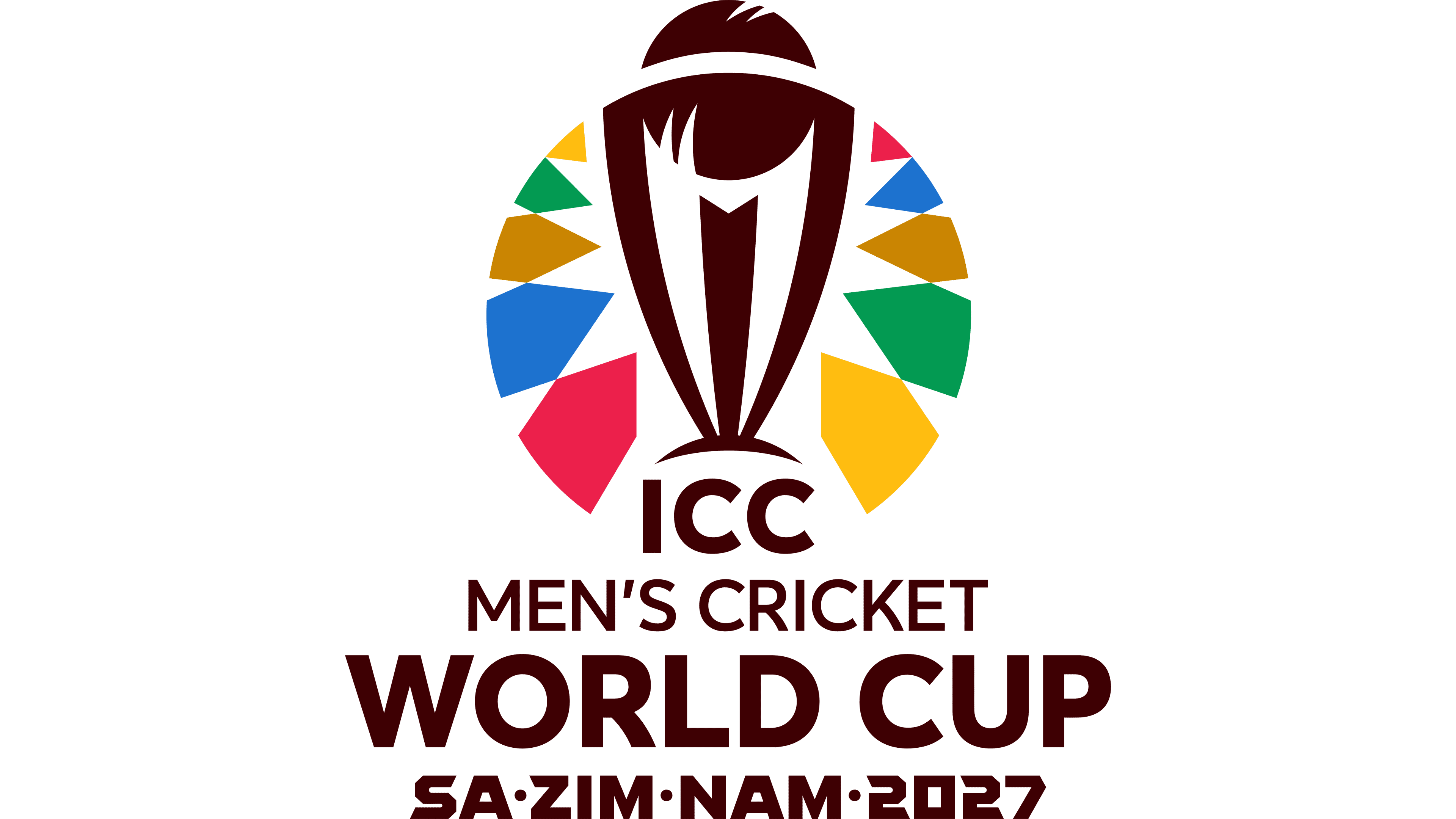
African wire bowls became one of the key references. Look at the emblem and the connection makes sense: separate pieces gather around the trophy to build an open circle. They do not match perfectly, nor are they meant to. Each keeps its own shape while still belonging to the whole. Three host countries, treated in much the same way.
There is another idea tucked into that circle: Ubuntu. At its simplest, it is about people existing through their relationships with others, and community being larger than the individual. That thought sits comfortably around a tournament shared across borders. “Make the Circle Bigger” picks up the same thread, turning the open ring into an invitation rather than a boundary.
And then there are the colors. They were not simply lifted from the three flags. The palette includes names such as Zimbabwe Chilli, Namib Dune, Fynbos Pop, Harare Dawn, African Root, and Two Oceans. Earth, coast, plants, cities. Small references from around the region, all mixed into one bright circle.
2026 — 2027

The tournament emblem places the Cricket World Cup trophy at the center of a broken circle made from colorful geometric pieces. Blue, green, yellow, red, and ochre shapes alternate around the dark burgundy trophy, creating something between a woven pattern and a radiant sun. Beneath it sits the ICC name, followed by Men’s Cricket and the much heavier World Cup inscription. The final line compresses the three hosts into “SA·ZIM·NAM·2027,” using centered dots to turn the location and year into one compact signature. BCKRDS, a Johannesburg design studio, created the identity.
Font and color
Two weights of the CWC family shape most of the lettering. CWC Bold is used for the large World Cup line, where the wide, heavy characters create a solid base for the emblem. CWC Medium handles the smaller ICC and Men’s Cricket wording. SA·ZIM·NAM·2027 is custom, with compact, squared letters and numerals arranged almost like a decorative border.
Burgundy takes the central role, filling the trophy and carrying the main lettering below. The ring is much brighter: green, blue, yellow, red, and ochre appear in irregular geometric sections separated by white. The palette draws on colors associated with southern African landscapes and culture, giving the emblem plenty of variation without losing the strong dark center.


